Showing posts with label freezer paper. Show all posts

Wednesday, June 19, 2019

Multitasking

Lots of quilting progress! It turns out that I get distinctly bored when sewing together 238 half square triangles. I am trying to remember the last time I made a quilt from one shape, and I think it was my bedspread a decade ago. At least I found this out before committing to a large quilt with this design, which I'd been considering. I have a mini design wall on my sewing desk, and transfer a sixth of the wheelchair quilt to that at a time for piecing. Here is it with three columns sewn so far.

I've also found the perfect solution, which is to alternate the wheelchair quilt with the temperature quilt. I sew four units of the wheelchair quilt, get them sewn into a column and attached to the previous column, then do one catchup day of the temperature quilt, and switching back and forth keeps me happy and motivated. I'm now caught up back to the start of April, working backwards. 

I should have put more gold in my fabric range, and am worried that I'll run out of the ombre fabrics for 12° and 17°, but otherwise its going well and starting to look very nifty. I joined Instagram, where there's a nice little community for making temperature quilts, and here is a mini tutorial I posted there on how I use freezer paper piecing for making the temperature quilt. 

Another odd thing about making the wheelchair quilt is that the pieces are 40% smaller when sewn than when they're laid out with their seam allowances showing, as they're only 3" half square triangles, and it throws me to see them together. I'm not sure why, maybe my brain is insisting that the smaller pieces are further away, and then realising that's not the case? Now that it's two-thirds sewn, it seems to be snapping back into making sense for my head, thankfully. 

Something I only realised about myself in the last year or so is just how neurodivergent I really am. It looks like autism and ADHD, though getting diagnosed as an adult woman is very hard, so I may never know officially. It is making it much easier to work out how different things exhaust me, which is an ongoing chore when you have ME/CFS wiping you out. Between that and finally figuring out the best way to use my Fitbit data (I colour the tablet status bar in  segments to show sleep, steps, heart rate and so on), I'm pacing myself far better. This also means I'm doing more quilting, which is an absolute joy. Well, either I'm pacing myself better, or I'm due for an almighty crash.

I definitely overdid it yesterday, and will need to be doing lots of resting under a cat for a few days. I had finally prepared the huge spiral stencil for R's bedspread, cutting it in between piecing the wheelchair quilt and temperature quilt (three things on the go suited me surprisingly well, I had a nice little routine set up), and brought it over to R's. It's A2, cut in such a way that if you want to make the bigger spirals, there's quite a lot of repositioning. 

Then I clipped the quilt onto the board we use to extend R's coffee table for board games, which covers just over a quarter of the quilt, and got half of it marked up over a couple of days. It's surprisingly tough work, especially on the legs, and naturally the marking pens decided to die near the end. I am hoping that the Crayola marker pens wash out as well as I remember, since with crowfooting you don't cover that much of the marking line with stitching.  So I'm in exhausted-but-smug mode. 

Still, that's several months' quilting prepared, and the quilt is now back on the bed and is a delight to work on. Despite having royally overdone it with the marking, I couldn't resist doing some quilting yesterday, and it is indeed much quicker, easier, and more fun to work on than traditional hand quilting. I've done three spirals so far, and am loving shifting the thread colours gradually for each one. The first one, which is the big extended spiral, was yellow - orange - pink - lavender, then one in four shades of sea green, and now I'm on one in different shades of blue. I keep getting urges to buy ALL THE THREADS, although I have some thing like 80 colours in perle #8 now and shouldn't need to. I admit to sneaking my DMC colour card out to check this morning, and there just aren't many of the brighter light blues anyway. I'm sure I'll be fine, I have boxes and boxes of thread.

Here is the quilt on the bed, being approved by the cat. You can see some of the crowfooting on the left. I really like the effect I'm getting with the different coloured  lines of stitching curving over the black sashing in particular.


Saturday, June 8, 2019

Notes for a 2020 temperature quilt.

I'm getting ideas for next year's temperature quilt, so I'll jot them down here and revisit them at the end of the year.

Use two strips per day again, but this time have the days running horizontally and the months vertically instead of vice versa.  Each month would have two rows of 14-16 days, or rather four rows including the highs and lows.

Put the lows above the highs this time, as they most often relate to the early morning rather than the late night, and it's bugging me.

This way the warm colours are going to flow across the centre horizontally, rather than being down the middle as with the 2019 quilt.

Make the rows curve.  This could be abstract swirls, or it could resemble mountains.  Do a new curve for each month, and then divide up the four rows within that, and then divide up according to days.  The height of the rows will vary, so I can change the width of the days to compensate for that a little, to give more evenly sized pieces.  Although that might look odd and unbalanced, and I may just have to live with some months getting more focus than others.  Perhaps try to keep the overall area occupied by each month consistent.  Is there a way of doing that with software?  Somhairle will likely have ideas.  Drawing a faint line for dividing it up into each month, and then making sure that the area of the curve above and below that line is roughly equal, should do the job.

Use tic marks on the freezer paper template to indicate how to join the curved rows together.

If January is at the top, then there will be a bigger area of cool temperature colours at the top than at the bottom.  Sky, then mountains, then a lake?

Make it wider than it is tall.

If going for a mountainy vibe, look at Scottish landscape pictures.  Tilt the colours more towards cool and greyed tones, perhaps put in lavenders in an unexpected place in the colour order, browns.

Alternatively, the summer could be a gold and fiery explosion coursing along the middle.  Think sun mosaics.  Some sort of triangles?

Use the 2019 quilt to get an idea of temperature distribution.  See how it works out to vary the high/low proportions according to the day/night length.

There will be much more distinct lines for each row this way, as an entire row will be highs, then lows, alternating all the way through.

Sunday, June 2, 2019

Temperature quilt: begun!

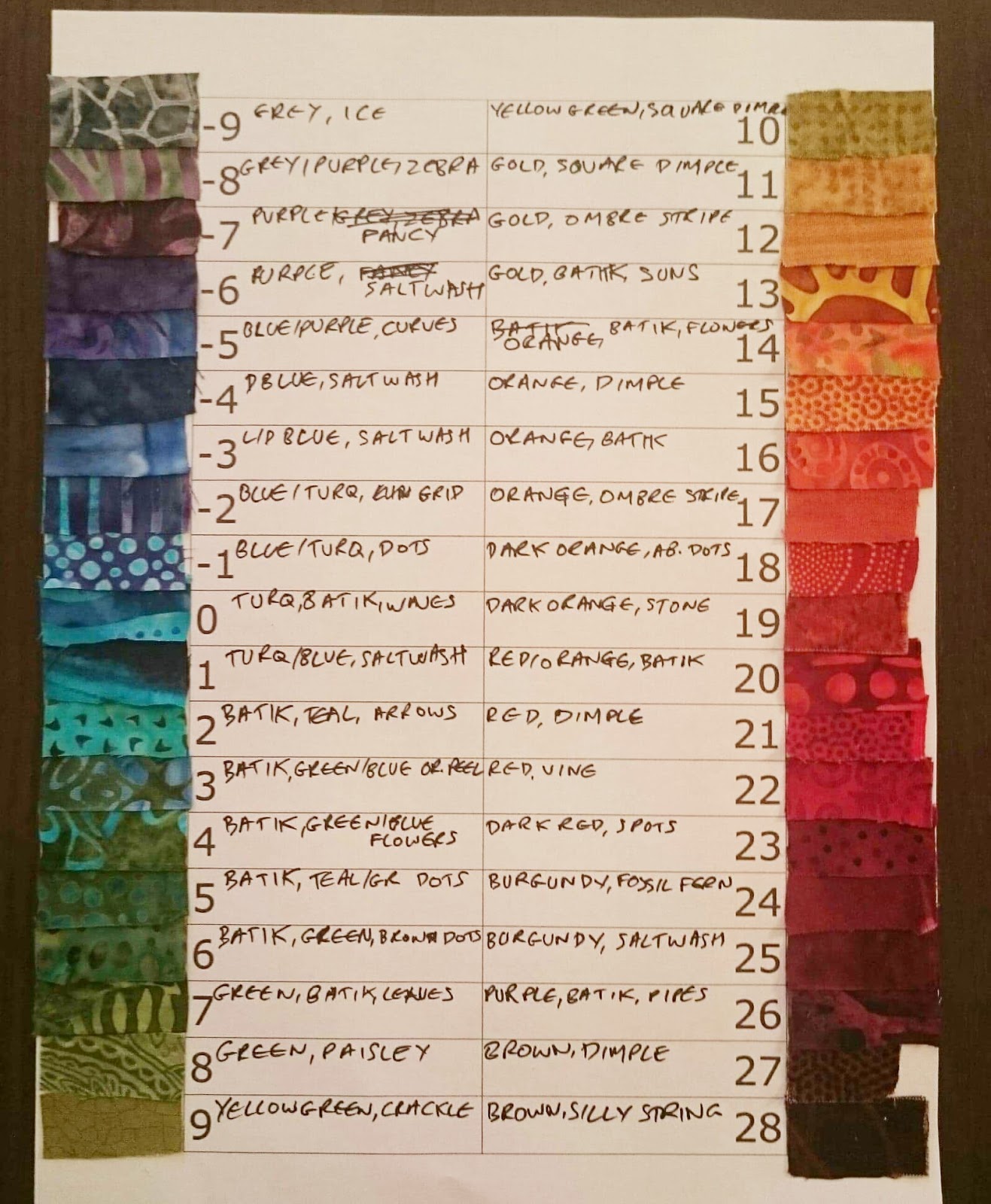
The temperature quilt is underway!  The prep was different and fun.  First of all, I had to gather my fabrics.  Someone doing a temperature quilt in Manchester advised me to use a different fabric for each degree C, and I'm glad she did, because you definitely need it.  I laid them out in a row, and then put every other one in the row above, to check how they fared when split up a bit.


I scrapped the second-bottom grey, it didn't quite fit, and the bottom grey can be divided into light and dark if need be.  That's for -9, which has only turned up once, so unless we have an unusually cold winter at the end of the year, it won't be a problem.  There was that year, 2010 I think, when the temperatures went down to -16 at night, but that was incredibly unusual, and we still talk of the snows and the difficulty the UK had in dealing with them.

Some fabrics are variably enough patterned that they could cover a few different temperatures, but I think that overall it will give the idea, and I am learning to relax and not worry about whether each fabric tells you the specific temperature unambiguously.  A little bit was cut off each to make a chart.

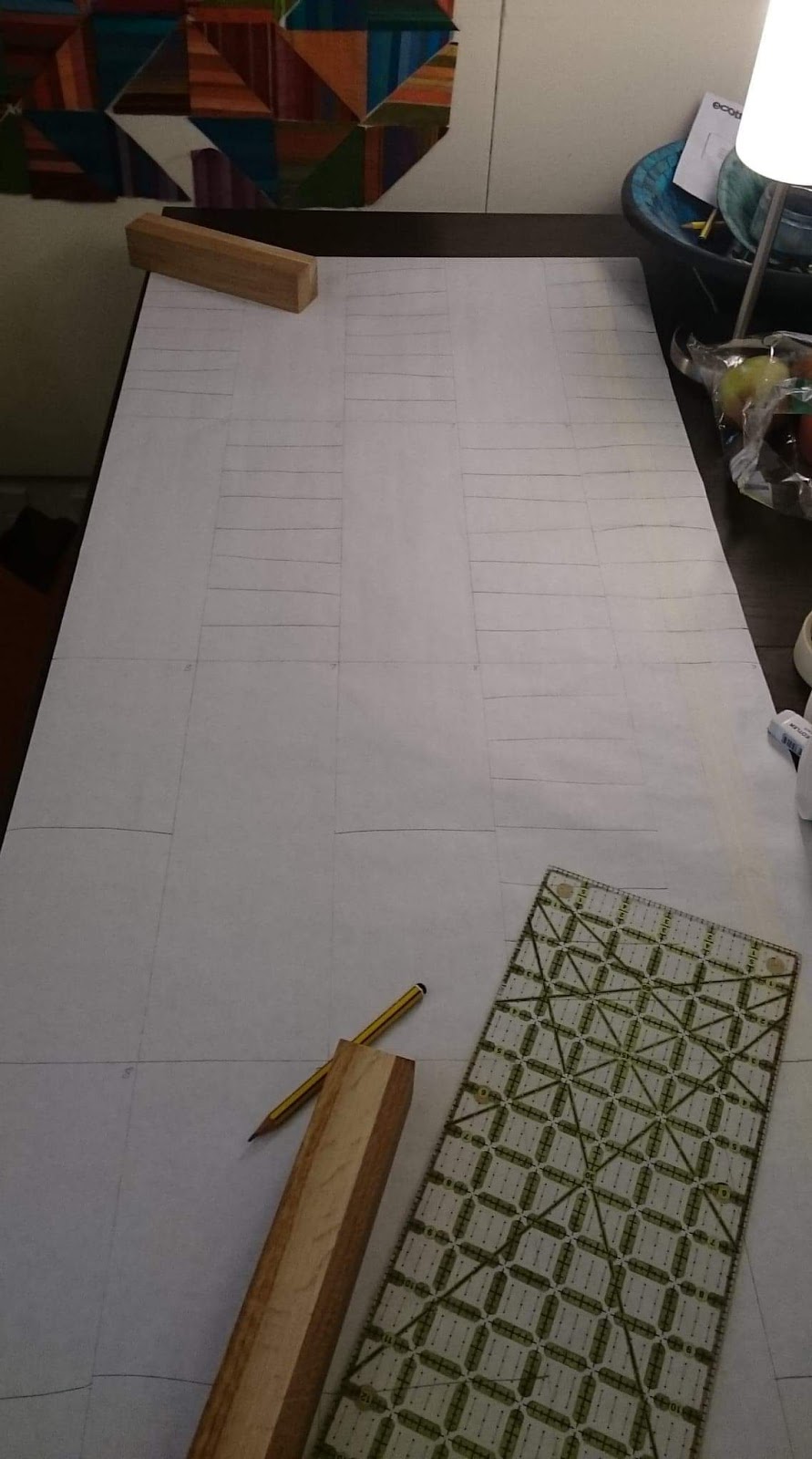
Next, I had to work out the pattern.  There was just enough freezer paper left, once I cut it up here and taped it together there.  I had been enjoying myself immensely the week before, making every possible chart in a spreadsheet.  That included working out which of the four sections per month would have 7 days and which would have 8 days, and then writing it all down reversed, because with freezer paper you are working in mirror image.

I drew my 4" x 12" sections with rulers, then subdivided them all into 7 or 8 days accordingly, and divided each of those sections into two, varying the proportions according to whether the day or night was longer on that date.  Marking them all up took a while, as they all needed the date, temperatures if the date had passed, and a little up arrow, which has proven to be invaluable.  I still ended up sewing two pieces together the wrong way around last night, but I noticed immediately and it was easily fixed.

Here's what they look like after each day's pieces have been cut up, ironed onto fabric, and the fabric has been marked up and the pieces drawn around.  After this, the pieces of paper are peeled off and binned, and the two pieces are sewn to each other, and then added to the seven or eight-day block they are part of. 

There's one piece for an earlier block where I copied in the wrong temperature and noticed a few days later, but it turned out to be fairly straightforward to unpick the offending piece, make a new paper template for it, and replace it with the right fabric.  It can be comforting to make mistakes early on, and know that you have a way to deal with them.

I was starting with the last block in May, but I wanted to see how this would look for a whole block, so I pulled out what I thought was the previous block for May.  It turned out to be the first block in May instead, leaving me with the two in between to catch up on.  I've now done the second one, so there's only the third to do and then the whole of May is done, as by now I've also finished the last block.  I've never been so interested in the weather forecast, and was downright excited when there was an overnight low 2 degrees that allowed me to use that pretty teal fabric for the first time.  I'll post the set once I've done that third block.

As expected, there are a lot of soft greens and golds together.  I'm really looking forward to seeing what the winter will look like, with those blues and greens, occasional purples and the odd flash of gold.  I've used a few reds so far, but I doubt I'll need them all that much.

It'll also show up starkly how unseasonal the weather is getting, like that worryingly warm patch in February, or the three hot days in April where I ended up basking in the hammock in R's garden in a tasteful nightie, because I didn't have any sundresses to hand.  I've noticed a couple of people on Instagram - Instagram appears to be The Place To Be for these quilts, and I finally sorted out joining - talking about how the weather is "in God's hands", which appears to be code for being climate change deniers.  Gah.  And when I'm seeing so many American quilters in Facebook groups talking about being flooded out, too.

Tuesday, May 21, 2019

Temperature quilt plans

I have this idea in my head that I only work on one quilt at a time.  OK, a piecing project at my flat and a quilting project for when I'm at R's flat every other week.  Fine, then, each of those, plus I have now fallen in love with temperature quilts, where you make a block each day.  That'll only be a little extra, right?

The idea with these is that you set out a code for which colour each temperature corresponds to, and then make a block for each day in the year, showing the temperature variations through the ebb and flow of colours.  I'm going to do the version with two pieces per day, one for the high temps and one for the low temps.  Since I'm starting halfway through the year, I'll make it to cover 2019, but when it gets to 2020, I'll be doing the block for that day for the previous year instead.  It's too much to catch up with otherwise.

There are several ways you can do this.  Flying geese blocks are popular, half-square triangles turn up in various incarnations, there are some exciting variants with hexagons, and sometimes people use strips.  If you are going to have the day of the month as your rows and the month as your columns, you end up with rectangular blocks if you want to end up with a square quilt.

Linen stack
I've decided to do two horizontal strips to make a block, stacked to make larger sections, which I suppose is a form of string quilt.  Right now I'm at R's and don't have access to my stash, but I've just received a set of linen blend samples in an order from Fabric Inspirations, so these work as a mock-up.  The strips won't be dead horizontal, but rather slightly angled and curved, giving it a more organic feel.

Temperature quilt by Erin

This is a traditional temperature quilt using flying geese, to give you an idea of how they most often look.  The centre triangle in each block shows the high temperatures, and the two smaller triangles on either side show the low temperatures.

As I will be using two strips for each day, I have divided each month into four sections, each made up of 7 or 8 days, so 14 or 16 strips.  After fretting a bit about whether I should try foundation piecing and if so how on earth to do it by hand, I realised that freezer paper templates will do the job beautifully.  I'll mark up some freezer paper, cut it into the sections, and then cut off each day's strips as I go.  The sections will be 4" x 12", giving a 48" quilt before borders.  That should be a nice size for a wall hanging, perhaps to go above my bed.

The quilter I got this idea from is Ann Brauer.  She makes beautiful quilts reminiscent of skies and seas, using lots of little stacked strips.  In her case, with machine piecing, she says she sews straight onto the batting, doing it in sections in a form of quilt as you go (QAYG).  I'm borrowing the sections idea, it seems to be enough to make it manageable to piece but not enough to take over and make it look too rigid.  Here is an example of her work, which shows how effective occasional contrasting strips can be.
Ann Brauer, Gentle Dawn
I love the way those deep oranges glow against the blues.

Ann Brauer, Purple Mountains

Ann Brauer, Summer on the Meadow
Looking at these made me realise that if I'm drawing those strips freehand, they don't have to be exact.  I can make the high temp strips taller when the days are shorter, and shorter in the winter when the days are longer.  I think that'll give a better feel for whether the warmer or cooler temperatures are more dominant, giving greater emphasis to the blue end of the colour range in the winter and the golds and reds in the summer.  It'll also add variety, along with the strip height naturally varying due to having either 7 or 8 days in a section.

The next question, of course, is colours.  Most of these quilts are based on a rainbow, often quite bright.  There's a lovely pair of flying geese quilts done by sisters in Alaska and California, where they've used similar colour schemes to produce very different results according to their different climates.  They're glorious, but they're brighter than I think I want in a large wall hanging.

Stacking those linen samples made me realise that a more muted colour scheme could look stunning.  I'm hoping to achieve something reminiscent of the Scottish landscape.  There will be lots of soft blues and greens, probably a few brownish colours on the way to the golds and rusts, and I want to try using lavenders, mauves and greys for the temperatures below freezing.  The "landscape quilts" section I'm building in my Pinterest is quite swoonworthy. Look at these, for example, by the textile artist Rachel Wright.

Rachel Wright, After the Storm

Rachel Wright, Into the Storm

Most of my stash is batiks, and while I think they will largely be too bright, there are plenty which have always been a bit too muted to use with the rest, and I'm eager to get home to them and see how they work together.

The quilt I'm actually working on at my flat is a little wheelchair quilt made from the scraps from R's bedspread, using randomised 3" half-square triangles.  I've already cut about a third of the pieces for that in one day, so it shouldn't take too long to get that part done.

I'll aim to begin the temperature quilt at the start of June, which gives me the next ten days to select fabrics and draw it out on the freezer paper, while also cutting my striped triangles for the wheelchair quilt.  R is away for a conference for the rest of this week, giving me the whole ten days in my flat instead of the usual week.  There will be much revelling in fabric!