I have this idea in my head that I only work on one quilt at a time. OK, a piecing project at my flat and a quilting project for when I'm at R's flat every other week. Fine, then, each of those, plus I have now fallen in love with temperature quilts, where you make a block each day. That'll only be a little extra, right?
The idea with these is that you set out a code for which colour each temperature corresponds to, and then make a block for each day in the year, showing the temperature variations through the ebb and flow of colours. I'm going to do the version with two pieces per day, one for the high temps and one for the low temps. Since I'm starting halfway through the year, I'll make it to cover 2019, but when it gets to 2020, I'll be doing the block for that day for the previous year instead. It's too much to catch up with otherwise.
There are several ways you can do this. Flying geese blocks are popular, half-square triangles turn up in various incarnations,
there are some exciting variants with hexagons, and sometimes people use strips. If you are going to have the day of the month as your rows and the month as your columns, you end up with rectangular blocks if you want to end up with a square quilt.
 |
| Linen stack |
I've decided to do two horizontal strips to make a block, stacked to make larger sections, which I suppose is a form of string quilt. Right now I'm at R's and don't have access to my stash, but I've just received a set of linen blend samples in an order from
Fabric Inspirations, so these work as a mock-up. The strips won't be dead horizontal, but rather slightly angled and curved, giving it a more organic feel.
 |
| Temperature quilt by Erin |
This is a traditional temperature quilt using flying geese, to give you an idea of how they most often look. The centre triangle in each block shows the high temperatures, and the two smaller triangles on either side show the low temperatures.
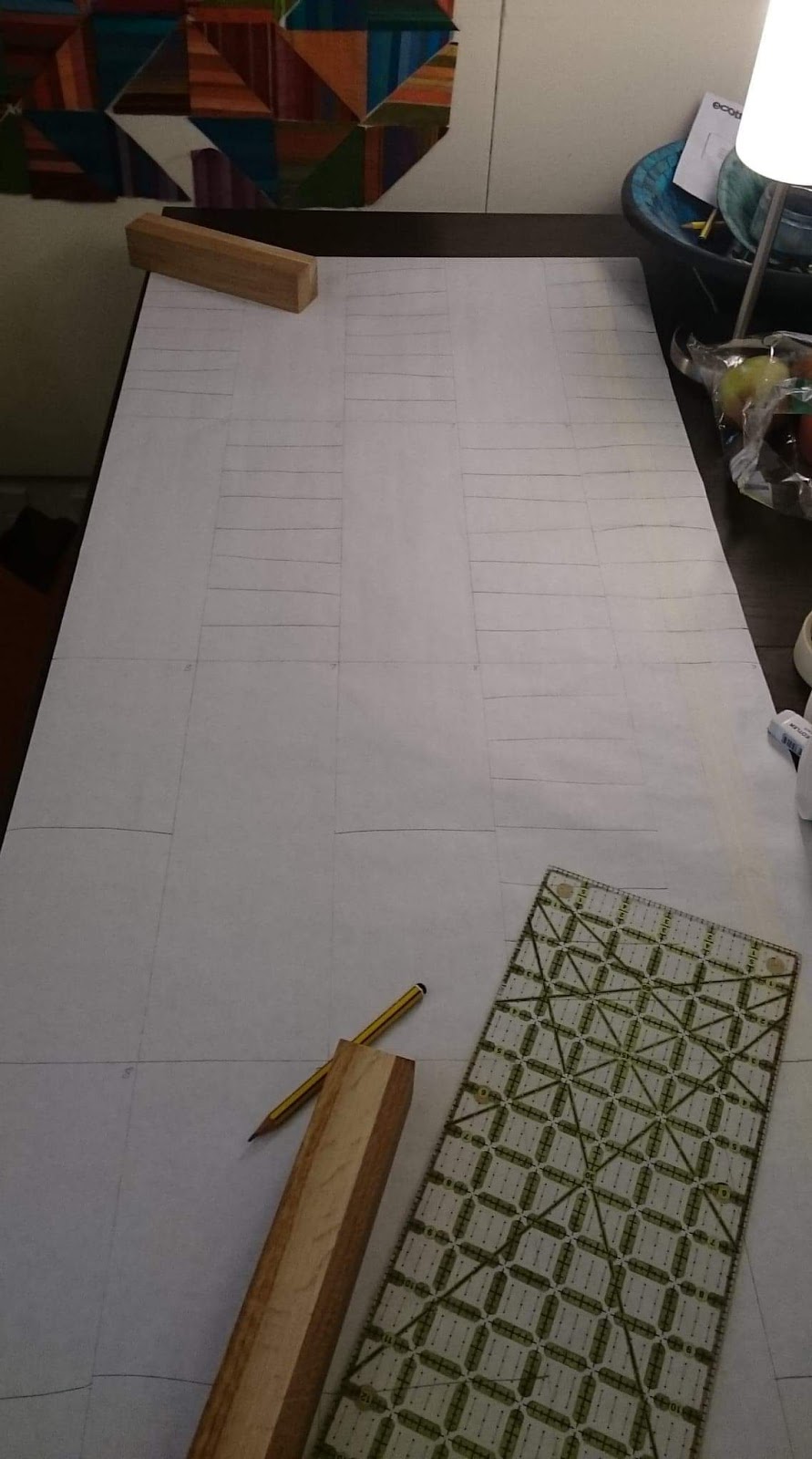
As I will be using two strips for each day, I have divided each month into four sections, each made up of 7 or 8 days, so 14 or 16 strips. After fretting a bit about whether I should try foundation piecing and if so how on earth to do it by hand, I realised that freezer paper templates will do the job beautifully. I'll mark up some freezer paper, cut it into the sections, and then cut off each day's strips as I go. The sections will be 4" x 12", giving a 48" quilt before borders. That should be a nice size for a wall hanging, perhaps to go above my bed.
The quilter I got this idea from is
Ann Brauer. She makes beautiful quilts reminiscent of skies and seas, using lots of little stacked strips. In her case, with machine piecing, she says she sews straight onto the batting, doing it in sections in a form of quilt as you go (QAYG). I'm borrowing the sections idea, it seems to be enough to make it manageable to piece but not enough to take over and make it look too rigid. Here is an example of her work, which shows how effective occasional contrasting strips can be.
 |
| Ann Brauer, Gentle Dawn |
I love the way those deep oranges glow against the blues.
 |
| Ann Brauer, Purple Mountains |
 |
| Ann Brauer, Summer on the Meadow |
Looking at these made me realise that if I'm drawing those strips freehand, they don't have to be exact. I can make the high temp strips taller when the days are shorter, and shorter in the winter when the days are longer. I think that'll give a better feel for whether the warmer or cooler temperatures are more dominant, giving greater emphasis to the blue end of the colour range in the winter and the golds and reds in the summer. It'll also add variety, along with the strip height naturally varying due to having either 7 or 8 days in a section.
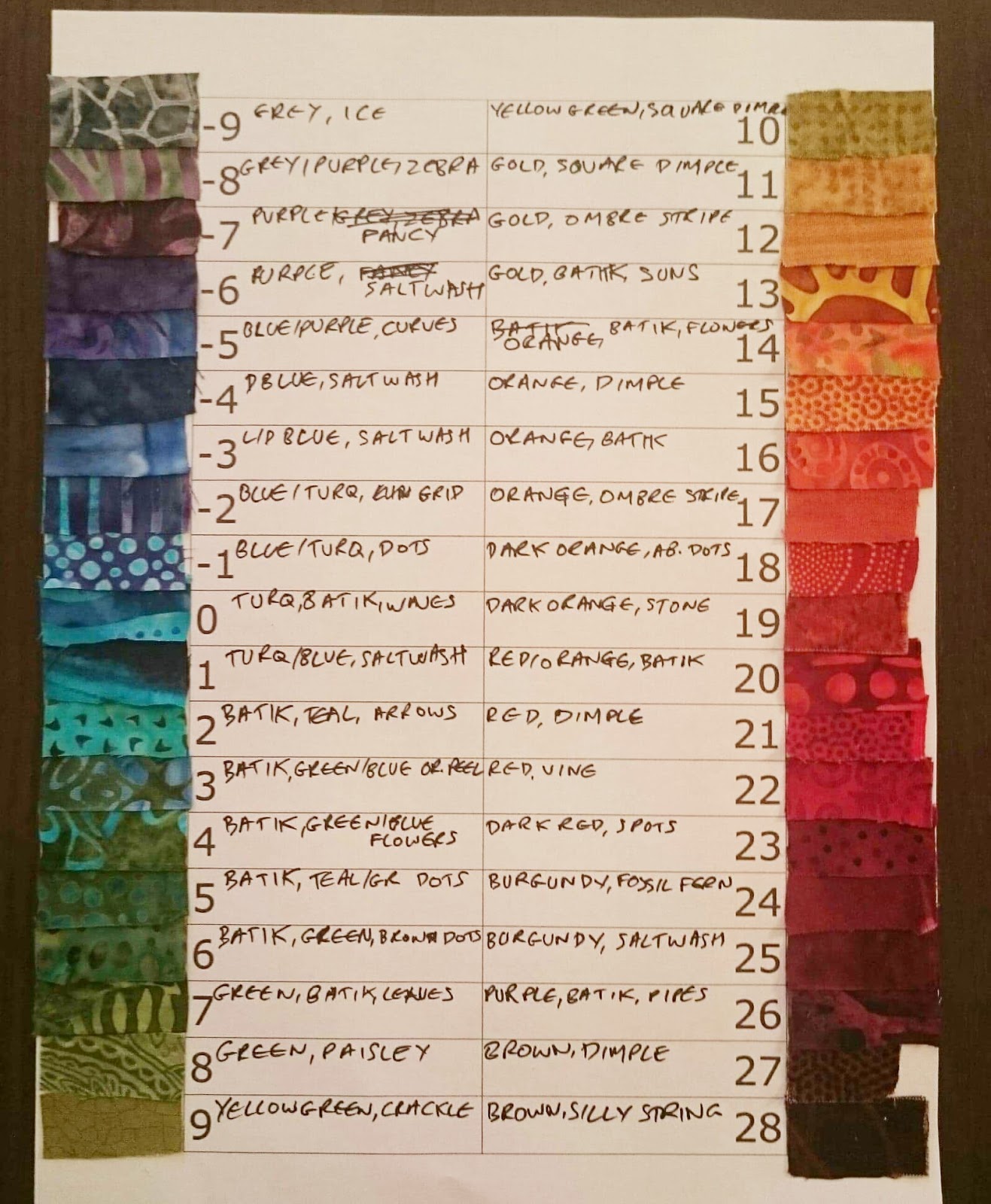
The next question, of course, is colours. Most of these quilts are based on a rainbow, often quite bright.
There's a lovely pair of flying geese quilts done by sisters in Alaska and California, where they've used similar colour schemes to produce very different results according to their different climates. They're glorious, but they're brighter than I think I want in a large wall hanging.
Stacking those linen samples made me realise that a more muted colour scheme could look stunning. I'm hoping to achieve something reminiscent of the Scottish landscape. There will be lots of soft blues and greens, probably a few brownish colours on the way to the golds and rusts, and I want to try using lavenders, mauves and greys for the temperatures below freezing. The
"landscape quilts" section I'm building in my Pinterest is quite swoonworthy. Look at these, for example, by the textile artist
Rachel Wright.
 |
| Rachel Wright, After the Storm |
 |
| Rachel Wright, Into the Storm |
Most of my stash is batiks, and while I think they will largely be too bright, there are plenty which have always been a bit too muted to use with the rest, and I'm eager to get home to them and see how they work together.
The quilt I'm actually working on at my flat is a little wheelchair quilt made from the scraps from R's bedspread, using randomised 3" half-square triangles. I've already cut about a third of the pieces for that in one day, so it shouldn't take too long to get that part done.
I'll aim to begin the temperature quilt at the start of June, which gives me the next ten days to select fabrics and draw it out on the freezer paper, while also cutting my striped triangles for the wheelchair quilt. R is away for a conference for the rest of this week, giving me the whole ten days in my flat instead of the usual week. There will be much revelling in fabric!